
About truth

I am writing this while the world is looking to Islamabad and the ceasefire discussions between Iran, Lebanon, Israel and the US.
Mars and Saturn are approaching. Mars is war and Saturn is brakes. So, ceasefire. But Saturn is debilitated and in Mars’ domicile, therefore Mars is certainly the stronger one. Both are in the bounds of benefics, so their intentions might be good. I don’t know the time of the meeting (I might post the chart later), but the Moon today sextiles both planets, and Saturn receives her in his domicile. Both benefics are in their own domicile or exaltation and and applying each other by sextile.
Mercury is still in Pisces in the bounds of Mars. While in Pisces, he is not applying any planet: Mars and Saturn are in aversion and the trine to Jupiter is already separative. This is the situation for today which will only change once Mercury enters Aries (April 15) , but I have written on this in my last post. I just wonder how words (Mercury) might fall into empty space today.
Mercury is the trickster when ill dignified and in a difficult house, but he can also be the one connecting the dots. There is a lot to say about him, but today, I’d like to start with a quote from Herodotus, which seems to be written for our time.
Herodotus, History (I.136), (I.138)
From the age of five to twenty [the Persians] are taught three things only: to ride, to draw the bow, and to speak the truth.
They consider it the most disgraceful thing in the world to tell a lie; the next worst, to owe a debt.
So this is post is about truth. As Democritus said:
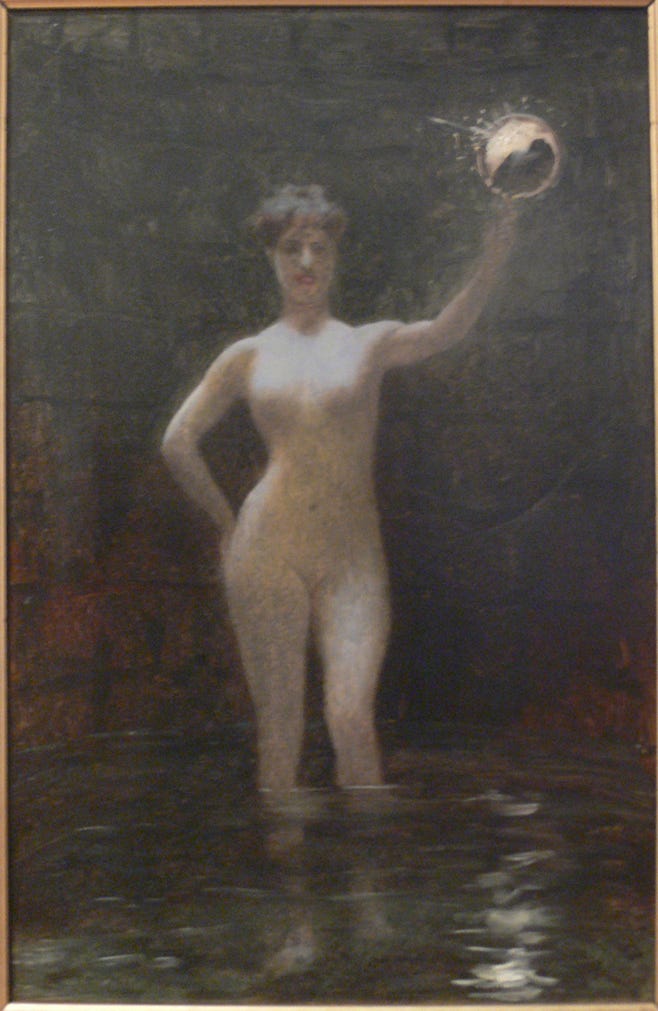
Of truth we know nothing, for truth is in a well.
So let’s get inspired by this lady (by Jean Gerome Leon)
Honesty is a virtue no longer appreciated in our society. We need to make everything appear “better” our résumé , our images, our reputation. We ask “how do you do”, but we never - ever- expect an honest answer.
Truth, we might assume, is a simple thing. Just don’t lie.
We are surrounded by illusions, produced by appealing marketing concepts of perfect couples or families, the perfect product, the must-have and the you-will-feel-better - solution to all our problems. The ideal weight, the dream career, the always understanding and loving parent, the stylish house. The list is endless. But marketing is just another word for lie.
Once the make-up is off, the nail polish is removed, the false eyelashes are put to rest in the drawer, and the video is switched off, at the end of the day, what is our truth?
Truth is not easy. There is story telling. And there are lies. Sometimes the line is very subtle. Fantasy and dishonesty are both alterations from “truth”. (And, btw., they are both Mercurian expressions. )
But what is truth, actually? Maybe it is easier to define lies? Lies are things that we tell knowing those things are not true. So there is a component of intention. But these intentions are not necessarily negative. Sometimes, we use lies to protect people. Or at least we think we do. For example, when somebody is terminally ill. I have seen this so many times. Friends and family either avoid the subject of death completely or they tell their loved ones they will get better soon. But if they do not honestly and wholeheartedly believe this themselves, they are telling a lie, even though their intentions are good.
But where is the difference between being truthful and telling people negative truths to their face ? How easy comes the sentence, “sorry I am just being honest”, even if we know it will hurt people? Can being honest actually be a weapon? Sometimes, telling what we think is true can worsen situations.
That’s the thing, again. What is true? A doctor who thinks the patient will die within 3 months? He can assume that chances are high, based on his/her experiences or similar cases, but is this actually the “truth”? And if it is not, what can this “truth” do if told to the patient? Should “truth” be told even if the patient has not asked for it? And what if s/he does?
How often do we think to “know” something, but our entire knowledge is only built on bits and pieces or a broader picture, based on discoveries, history and collective learning? Not to mention out religious, scientific and political credos.
These credos change over time. So can they even be considered as “truths”?
Isaac Asimov:
Science is a self-correcting system… the theories that are wrong are replaced by better ones.
He also said
When people thought the Earth was flat, they were wrong. When they thought it was spherical, they were wrong… but if you think that thinking the Earth is spherical is just as wrong as thinking it is flat, then your view is wronger than both of them.
Or this quote from Thomas Kuhn:
Scientific revolutions… replace one paradigm with another.
I also like this from Karl Popper:
We can never be certain that our theories are true; we can only be certain that they are false.
Not lying sometimes implies to speak less. Not just that. If somebody asks ask for or opinion on something we can
1) criticize the work or pieces of it
2) Underline a weak point and suggest an improvement
In the first case we are energy vampires and make our friend feel powerless. The second option gives the person something to work on, if we do not patronize this person.
However “our opinion” again, is not necessarily “the truth”. I think this is why Paramahansa Yogananda advised his disciples that if people cannot say something positive, they should stay silent. This implies that we should give our opinion only if directly requested. That, I think is a virtue by itself, especially in times of social media.
So my question is: can consequent truth bring peace?
That’s it for today!
© Tania Daniels 2026
-Image: Truth coming out of the well by Jean Gerome Leon